
Professional Engineer Program, BINUS University Promotes Agricultural Innovation Through Drone Sprayer Technology: A Commitment to Empowering Society and BINUS Vision 2035
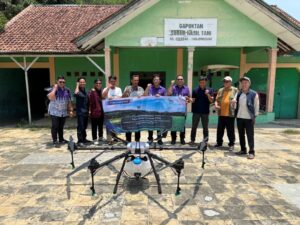
In the face of global difficulties to sustain food security and enhance farmer welfare, technology is essential for resolving productivity and efficiency problems in the agricultural industry. The use of drone sprayers, an automated spraying device that can increase efficacy, farmer safety, and environmental benefits, is one invention that is now growing rapidly in many nations.
To address this challenge, BINUS University lecturers Ir. Tota Pirdo Kasih, S.T., M.Eng., Ph.D., IPM, and Ir. Alfian Destha Joanda, S.T., M.T., IPM, Asean Eng, took the initiative to develop and implement agricultural mechanization innovations using drone sprayers as a real solution for farmers in Indonesia. This initiative aligns with BINUS University’s vision as “A world-class university that fosters and empowers communities to build and serve the nation,” while also supporting the sustainable development goals of SDGs Goal 2: Zero Hunger and Goal 9: Industry, Innovation, and Infrastructure.
The focus of this activity is in East Bogor, specifically Cibadak Village, Tanjungsari District, Bogor Regency, West Java, an area with high agricultural potential but still facing limited access to modern technology. Through training and outreach on the use of drone sprayers, BINUS lecturers strive to empower farmers and local communities to leverage technological innovations to increase crop yields, improve work efficiency, and enhance safety in the field.
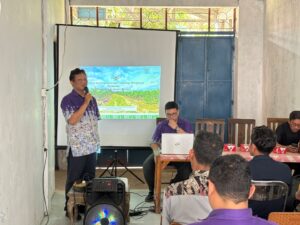
During this series of activities, PSPPI Binus team also presented a prototype of a Special Nozzle Housing for agricultural drones, a technology that can replace standard nozzle components. This prototype represents a significant advancement in precision agriculture technology. This component is designed to facilitate the installation and interchangeability of spray nozzles in a modular manner, with each nozzle having specific characteristics that can be tailored to various crop types and phytosanitary treatment needs. The presence of this technology is expected to expand the adaptability of drone sprayers, enabling them to provide more targeted and efficient treatments.
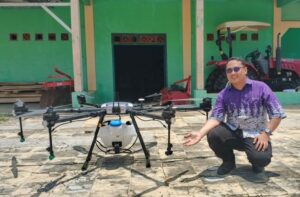
“We want to demonstrate that technology is not just the preserve of large industries, but can be a tool for empowering communities. Through this initiative, we hope farmers in West Java can be more productive and competitive,” said Ir. Tota Pirdo Kasih, S.T., M.Eng., Ph.D., IPM.
Meanwhile, Ir. Alfian Destha Joanda, S.T., M.T., IPM added, “For us, the role of lecturers doesn’t stop in the classroom. We want to have a direct impact on society, so that technology can truly be felt to improve the quality of life.”
Through this initiative, BINUS University has once again been recognized as an educational institution that encourages collaboration between academia, industry, and the community.
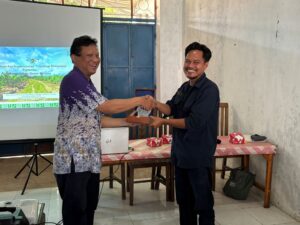
In addition to strengthening the Four Pillars of Higher Education, this activity also reflects the spirit of BINUS’s Vision 2035 to foster and empower communities through the implementation of relevant and sustainable innovations.
Comments :